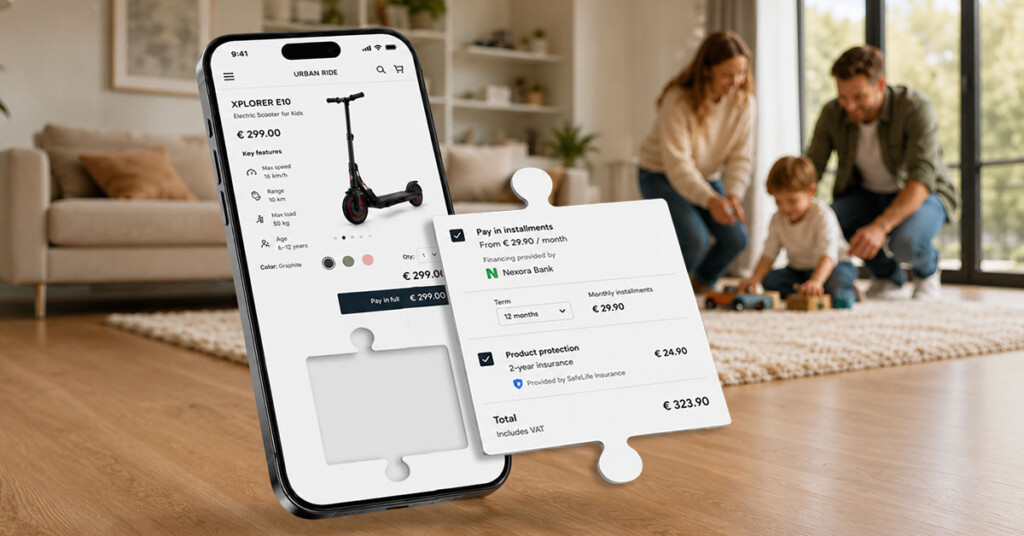


E-BOOK
Build, Buy, or
Orchestrate?
Rethinking Commerce
From System Selection to Decision Architecture
Executive
Summary
Many companies begin their commerce transformation with the wrong question:
Which platform do we need?
Yet sustainable digital business models are not created through system decisions — they emerge from deliberate architectural choices.
Today, the debate is no longer about build vs. buy.
It is about:
-
Where is standardization sufficient?
-
Where does value emerge through composition?
-
Where do we need true differentiation?
This framework outlines how companies can design their commerce landscape as a controllable decision architecture — rather than a rigid shop system.
In this
e-book
01 | Why Traditional Selection Processes Are No Longer Enough
02 | Commerce Has Become Decision Architecture
03 | The Three Decision Zones of Modern Commerce Architectures
04 | New Risks — Beyond Cost and Time-to-Market
05 | Organization Shapes Architecture
06 | Rethinking the MVP
07 | Outcome: Commerce Becomes Controllable
01 |
Why Traditional Selection Processes Are No Longer Enough
Conventional e-commerce evaluations tend to compare:
-
Features
-
Vendors
-
Licensing models
-
Implementation effort
But modern commerce landscapes are no longer built around a single system. They consist of:
-
Data logics
-
Decision rules
-
Services
-
Partner integrations
-
Experience layers
The central question is therefore no longer: Which solution fits us?
But rather: Which capabilities must we control to remain adaptable in the long term?
02 |
Commerce Has Become Decision Architecture
In the past, systems defined what was possible.
Today, architecture defines future viability.
Commerce has evolved into a combination of:
-
Decision logic
-
API orchestration
-
Data governance
-
Ecosystem integration
The decisive strategic question is:
What must remain stable — and what must be able to evolve?
Technology Becomes a Building Block
Platforms, SaaS, microservices, or greenfield approaches are no longer strategies in themselves. They are components within a broader architecture.
Modern commerce landscapes emerge from the deliberate combination of:
-
Standard components
-
Orchestrated services
-
Custom decision logic
It is not the technology that determines adaptability — but how it is applied.
03 |

The Three Decision Zones of Modern Commerce Architectures
Modern commerce architectures do not emerge from a single system.
They emerge from deliberate decisions about where a company needs:
-
efficiency
-
speed
-
control
Not every commerce capability warrants the same degree of individuality.
Some should be consciously standardized.
Others must remain flexibly composable.
And a few are so central to the business model that they must stay under direct control.
This gives rise to three decision zones.
1. Standardize
Where individuality does not create competitive advantage.
These capabilities must function reliably — but they do not differentiate your company in the market.
Customers do not choose you because your checkout is unique.
They simply expect it to work seamlessly.
Typical examples:
-
Checkout
-
Payment
-
Tax and compliance logic
-
Core CMS capabilities
Here, standardization pays off. It reduces complexity, lowers operating costs, and ensures stability.
The goal is not differentiation — but reliability.
3. Differentiate
Where your business model is decided.
Some capabilities determine how you generate revenue, shape offerings, or build customer relationships. This is where true competition emerges. These areas should not be fully standardized, as they directly define your value proposition.
Typical examples:
-
Pricing logic
-
Bundling and offer design
-
Contract logic
-
Subscription models
-
Offer configuration
-
Data models
These capabilities define how you sell — not just what you sell.
The goal is strategic control.
Future-ready commerce architectures do not result from maximum individuality, but from deliberate choices:
What do we standardize?
What do we compose?
And what do we retain under our own control?
04 |
New Risks — Beyond Cost and Time-to-Market
In the past, the focus was on:
-
Licensing costs
-
Implementation timelines
-
Resource requirements
Today, different risks define success:
Risk of rigidity
When differentiation becomes trapped in standard software
Risk of fragmentation
When composition happens without governance
Risk of loss of control
When data sovereignty is lacking
05 |
True adaptability emerges only when organization and architecture are aligned.
Technology can enable modularity.
Only the organization can make it usable.
06 |

Rethinking the MVP
Today, a Minimum Viable Product is no longer a minimal shop.
It is a minimal value flow.
In traditional commerce projects, an MVP often includes:
-
Product display
-
Shopping cart
-
Checkout
Technically functional — but not yet economically effective.
Because visibility is not the same as business.
A modern MVP does not focus on features, but on the ability to generate value.
The key question is no longer: Which functions do we need for go-live?
But rather: Which capabilities do we need to realize real revenue?
A value-oriented MVP therefore focuses on the building blocks that enable and scale actual transactions.
Typical MVP capabilities include:
-
Offer capability — the ability to present products, services, or bundles in context
-
Pricing logic — the ability to determine prices dynamically or rule-based
-
Contracting — the ability to formally establish business relationships
-
Partner integration — the ability to include third parties in the value flow
Together, these capabilities form the smallest functioning business process — not just a digital interface.
The distinction is critical:
A feature MVP demonstrates that technology works.
A value MVP demonstrates that business models work.
This is how real business value is created early — not just functionality.
07 |
Outcome: Commerce Becomes Controllable
The future of e-commerce does not belong to the best platforms, but to the companies that understand:
-
where standardization is sufficient
-
where composition creates speed
-
where differentiation is essential
Companies that approach commerce as a decision architecture:
-
scale faster
-
integrate more easily
-
differentiate more deliberately
-
remain technologically adaptable
Download

Download the free e-book “Rethinking Commerce”.
How does commerce evolve from a store to a strategic decision-making architecture? This e-book demonstrates how companies are reshaping their digital value creation. Simply fill out the form to receive the E-Book as a PDF.
Let’s talk
Do you need a specific offer or a sparring partner to discuss ideas?
Just contact us:
- experts@striped-giraffe.com
- +49 (0)89-416 126-667
We will be happy to support you.
WE CREATE ADDED VALUE FOR OUR CUSTOMERS.
This leads to a long-term cooperation with our customers, which we appreciate very much. You can find even more e-books, case studies, and co. in our Insights.