



by Striped Giraffe Team
9. February 2026
Reading time: 9 Minutes
Real-World Applications of Data Anonymization Across Industries
Few technologies manage to reconcile two opposing imperatives — the hunger for insight and the duty of discretion. Data anonymization does.
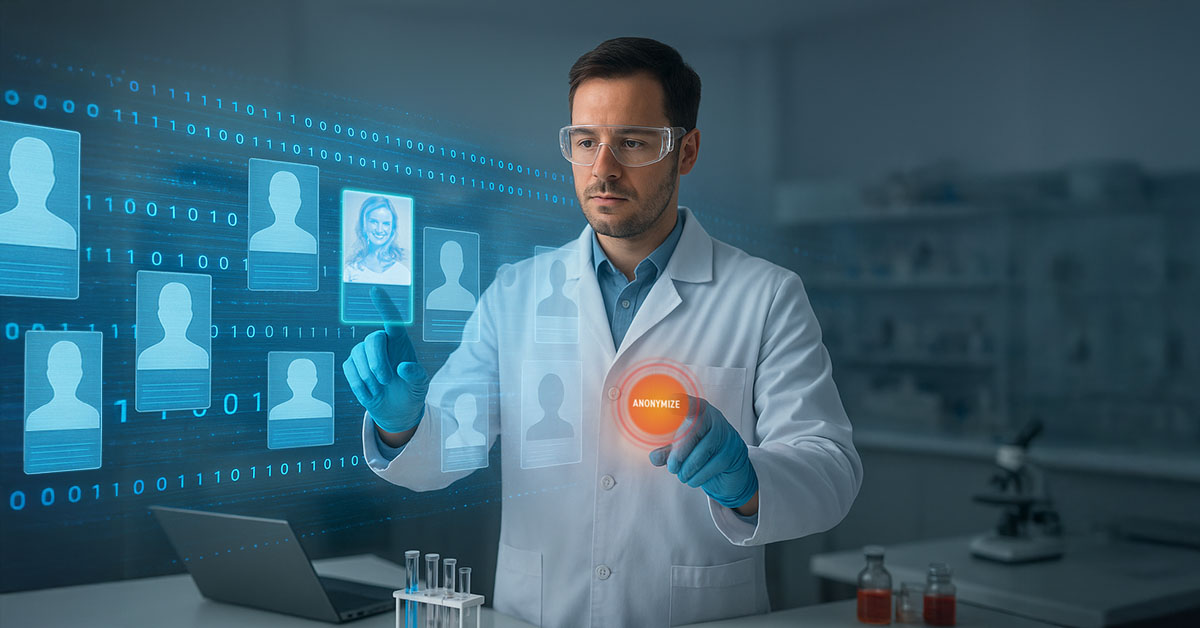
Data anonymization has quietly become one of the most powerful instruments of digital cooperation. It allows data to move — between teams, companies, and even competitors — without crossing the lines of privacy. What once was seen as a defensive measure is now emerging as a catalyst of progress.
When applied with precision and context awareness, anonymization transforms data that cannot be shared into knowledge that can be acted upon — as we showed in the first part of this series, where we explored the underlying principles, methods, and trade-offs behind effective anonymization.
The growing adoption of anonymization across industries marks a quiet shift in how organizations perceive data privacy. It’s no longer just about compliance or ethical responsibility. It’s about creating a trusted space where innovation can happen — responsibly, collaboratively, and at scale.
🚘 Automotive and Mobility
Modern vehicles are moving data centers. Every mile generates images, GPS coordinates, sensor readings, and behavioral traces — all of which may expose identifiable details such as faces, license plates, home addresses, or driving patterns.
As automakers collaborate with AI startups, mapping providers, and regulators, data anonymization becomes the passport for cross-organizational innovation without breaching privacy laws such as the GDPR.
Typical data anonymized
- Video streams (faces, license plates, pedestrians)
- GPS traces and location metadata
- Vehicle identifiers linked to telematics logs
- Sensor fusion data when combined with route or time markers
Potential use cases
- Anonymization of vehicle sensor and camera data for internal testing and validation of autonomous driving and advanced driver-assistance systems (ADAS).
- Processing connected vehicle telematics to monitor fleet performance and predictive maintenance while masking individual driver identities.
- Exchanging anonymized sensor and environmental data between automotive manufacturers for collaborative development of autonomous driving algorithms and safety testing.
- Sharing anonymized telematics and mobility data with urban planners to optimize traffic flow, parking infrastructure, and public transport systems.
Real-world initiatives
- Audi A2D2 (Audi Autonomous Driving Dataset) applied automated blurring to faces and license plates before releasing its perception dataset publicly. This allowed external researchers to work with real-world driving data without violating EU privacy standards.
- Companies like Brighter AI and Celantur specialize in privacy-preserving video anonymization for connected vehicles — using AI-based pixel replacement or synthetic overlays instead of simple blur to prevent re-identification. These technologies enable OEMs to share test data with engineering partners safely.
- European mobility projects such as SimRa (Safety in Bicycle Traffic) — led by Technische Universität Berlin — use anonymized route and event data from cyclists to support urban planning and traffic safety research, showing how anonymization fuels collaboration between industry, academia, and cities.
Risks
Location data can still enable re-identification when combined with external sources (e.g., home addresses, parking habits). Privacy-by-design frameworks such as ISO/TS 29003 and EDPB guidance recommend context-specific aggregation and perturbation to mitigate this.
🏛️ Banking and Finance
In financial services, transaction histories, behavioral analytics, and credit records are rich in personal insights — but also highly sensitive. Banks must balance innovation in fraud detection and AI-driven credit scoring with regulatory obligations like PSD2 and GDPR.
Typical data anonymized
- Payment transactions (names, account numbers replaced or hashed)
- Credit histories and spending patterns
- Customer demographics tied to location or income
Potential use cases
- Anonymization of customer transaction and credit data for internal fraud detection, risk assessment, and predictive modeling.
- Masking sensitive information in customer behavior datasets to enable internal analytics and product optimization.
- Providing anonymized transactional datasets to fintech companies or regulators for fraud pattern detection, financial risk modeling, and compliance benchmarking.
- Sharing anonymized credit behavior data between banks to support collaborative credit scoring models or market trend analyses.
Real-world initiatives
- The Bank of England’s anonymized transaction data sandbox allows researchers to analyze spending behavior without access to identifiable customer records.
- Several major European banks collaborate with fintech startups through shared anonymized datasets to improve fraud models. Data is masked or tokenized before leaving internal systems, allowing third parties to detect suspicious patterns without seeing account identifiers.
- The European Central Bank (ECB) and the European Banking Authority (EBA) have both endorsed the use of anonymized financial data in regulatory sandboxes to support responsible innovation.
Risks
Even de-identified financial data can be vulnerable to linkage attacks if patterns are unique (e.g., rare spending combinations). Re-identification studies have shown that as few as three transactions can identify a customer with >80% probability if combined with external data. Continuous monitoring of k-anonymity thresholds is essential.

🏗️ Construction and Smart Infrastructure
As construction becomes digitalized, projects rely on IoT devices, smart sensors, and wearables — all of which collect information about workers, building occupancy, and environmental conditions. These datasets are crucial for safety, efficiency, and sustainability, but they also contain traces of personal information.
Typical data anonymized
IoT sensor readings (linked to time, room, or device ID)
- Worker wearables (biometric or motion data)
- Building usage and location-based metrics
Potential use cases
- Anonymization of sensor data from smart buildings, including environmental and occupancy measurements, for internal monitoring of energy usage, occupancy, and site efficiency.
- Processing wearable IoT data from construction workers in an anonymized manner to monitor safety, ergonomics, and health without compromising personal identities.
- Sharing anonymized construction site or building performance data with research institutions, urban planners, or regulatory bodies for collaborative studies, safety benchmarking, and sustainable development initiatives.
Real-world initiatives
- Skanska and Autodesk have experimented with anonymized wearable data to track safety compliance and ergonomics on construction sites. Personal identifiers are stripped before data aggregation to focus only on movement patterns and hazard events.
- Smart building projects in Europe, such as EU Horizon’s SmartBuilt4EU, use anonymized sensor data (temperature, CO₂, occupancy) to optimize energy management while preserving occupant privacy.
Risks
Combining location, time, and movement data may still allow re-identification of individuals (e.g., unique shift patterns). Aggregation and temporal generalization help reduce these risks.
🛒 E-commerce
Every click, view, and purchase in e-commerce reveals behavioral insights. Yet linking this data to identifiable customers exposes privacy risks — especially when collaborating with marketing partners or AI vendors. Anonymization enables analytics that respect identity boundaries.
Typical data anonymized
- Browsing histories and session logs
- Transactional and payment records
- Device IDs and behavioral sequences
Potential use cases
- Anonymizing customer browsing, purchasing, and interaction data to enable internal analytics without exposing personally identifiable information.
- Use of anonymized transaction data to detect and prevent fraudulent activities while safeguarding customer privacy.
- Sharing anonymized sales and transaction data across e-commerce platforms to improve fraud detection models and consumer behavior research.
Real-world initiatives
- Amazon’s differential privacy research and Google’s open-source differential privacy frameworks have influenced retail analytics, where anonymization supports trend analysis without revealing user-level behavior.
- European e-commerce consortia have experimented with sharing anonymized fraud data to train collective detection models — using hashed transaction IDs and synthetic augmentation to prevent exposure of actual users.
- Shopify applies pseudonymization and anonymization layers to aggregated merchant and consumer analytics to comply with GDPR while still enabling product optimization.
Risks
Even anonymized behavioral data can allow inference of identities if cross-referenced with known purchase patterns. Combining anonymization with synthetic data generation mitigates linkage risks.

💊 Healthcare and Pharmaceuticals
No domain handles more sensitive data than healthcare. Patient records, genetic profiles, and clinical trial data are lifelines of research — but also legally protected under GDPR, HIPAA, and EMA guidelines.
Typical data anonymized
- Electronic health records (EHRs) and lab results
- Imaging data (CT, MRI, pathology slides)
- Genomic sequences and drug usage logs
Potential use cases
- Anonymization of patient records and clinical trial data for internal research, AI model training, and service improvement.
- Processing anonymized telemedicine and wearable health data to monitor outcomes and improve care delivery while protecting privacy.
- Sharing anonymized health and drug usage datasets between hospitals, research institutions, and regulatory authorities to advance epidemiological studies, pharmacovigilance, and collaborative research.
- Collaborative development of AI models for diagnostics or treatment prediction using anonymized multi-institutional health datasets.
Real-world initiatives
- ClinicalTrials.gov, operated by the U.S. National Institutes of Health (NIH), requires anonymization of all published clinical trial records to ensure research transparency without compromising participant privacy.
- The YODA Project (Yale Open Data Access), run by Yale University, provides a framework for sharing anonymized clinical trial data between pharmaceutical companies and independent researchers under clear ethical governance.
- European Medicines Agency (EMA) enforces anonymization of patient-level data in submissions made public under its data transparency policy.
- UK NHS Digital’s Data Access Environment (DAE) provides researchers with de-identified datasets for epidemiological studies and AI development under strict governance.
Risks
Re-identification risks persist when indirect identifiers — such as rare diseases, treatment timelines, or genetic variants — can be cross-matched with public data. EMA recommends quantitative risk assessment and expert review before release.
Conclusion
Anonymization doesn’t strip data of its meaning. It refines it — distilling only what’s needed to drive understanding while removing what should never leave the source.
Across all discussed sectors, anonymization not only supports regulatory compliance but also enables organizations to unlock the value of sensitive data safely, facilitating innovation, research, and operational efficiency.
As industries grow more interconnected, the ability to separate identity from insight will decide who can innovate safely — and who will be left behind, constrained by their own data silos.
In this sense, anonymization is not an act of concealment. It is an act of liberation — allowing information to flow, connect, and create value without crossing ethical or legal boundaries.
You might also like:
- Data Anonymization, Part 1: Turning Sensitive Information into Strategic Value » Learn more
- Agentic Commerce, Part 1: Where Conversations Become Transactions » Learn more
- How buzzwords could put your IT at risk » Learn more
- Mastering software delivery: Overcoming development hurdles » Learn more
- How to choose the right IT service provider » Learn more