

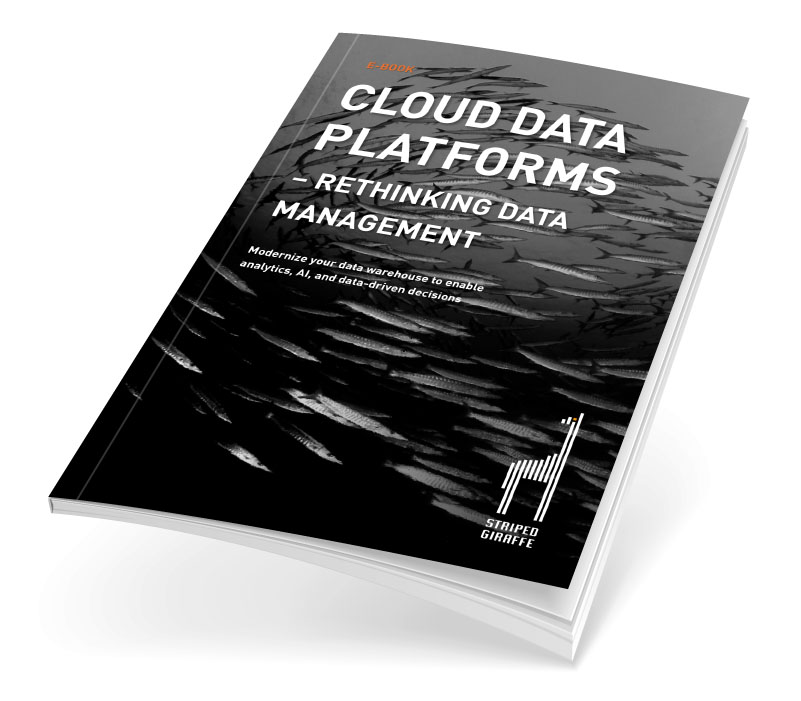
E-Book
Cloud Data Platforms – Rethinking Data Management
Modernize your data warehouse to enable analytics, AI, and data-driven decisions.
In this
e-book
01 | Executive Summary
Context, objectives, and strategic relevance of modern cloud data platforms
02 | Why Classical Data Warehouses Reach Their Limits
Technical, organizational, and regulatory drivers for modernization
03 | Cloud Data Warehouse, Lakehouse, and Data Platform Compared
Clear definitions and architectural models explained
04 | Reference Architectures for Modern Cloud Data Platforms
Core components, design principles, and scalable target architectures
05 | Data Mesh and Data Fabric Explained
Domain ownership, platform enablement, and intelligent data connectivity
06 | Data Governance, Security, and Compliance by Design
Why governance, privacy, and security are foundational to data platforms
07 | Analytics, Generative AI, and LLM Readiness
Cloud data platforms as the foundation for advanced analytics and AI
08 | Cloud Data Warehouse Migration and Modernization
Evolutionary strategies for transitioning from legacy systems
09 | Operating Cloud Data Platforms: Cost, Performance, and FinOps
Managing scalability, cost efficiency, and operational excellence
10 | Conclusion: Cloud Data Platforms as a Strategic Foundation
Enabling sustainable, data-driven business models
01 |
Executive Summary
Data has become a central production factor for modern organizations. At the same time, many companies are struggling to align legacy data warehouse architectures with cloud technologies, increasing regulatory requirements, and new forms of data consumption driven by analytics and artificial intelligence. Purely technical cloud migrations often fall short if they lack a clear strategic foundation.
This e-book explains how cloud data warehouses evolve into integrated cloud data platforms. It classifies current architectural concepts such as lakehouse, data mesh, and data fabric, highlights the role of governance, security, and compliance, and outlines how generative AI and large language models (LLMs) build on a reliable data foundation. The goal is to provide decision-makers with clear, future-proof guidance for modern data management.
02 |
Why classical data warehouses reach their limits
For decades, centralized data warehouses formed the backbone of data-driven organizations. They consolidated structured data, enabled reporting, and supported management decisions. However, the underlying conditions have changed fundamentally.
Today, organizations process significantly larger data volumes from a wide variety of internal and external sources. Beyond traditional ERP and CRM systems, log data, sensor data, APIs, unstructured content, and near-real-time streams have become essential. At the same time, business units expect faster insights, self-service analytics, and flexible data models.
Legacy data warehouses are often ill-equipped to meet these demands. They tend to be costly to operate, difficult to scale, and tightly coupled to rigid data models. Increasing regulatory pressure, security requirements, and the shortage of specialists for legacy technologies further accelerate the need for modernization.
Modernizing data management is therefore not merely a technological option but a strategic imperative.
03 |
Cloud data warehouse, lakehouse, and data platform – a comparison
A cloud data warehouse initially refers to the migration of analytical databases to a cloud infrastructure. Compared to on-premise systems, cloud data warehouses offer elastic scalability, usage-based pricing, and significantly reduced operational effort.
In practice, however, an isolated cloud data warehouse is rarely sufficient. Modern data architectures combine multiple storage and processing concepts:
- Data lakes for cost-efficient storage of large volumes of structured and unstructured raw data
- Cloud data warehouses for high-performance analytical queries, reporting, and BI
- Lakehouse approaches that more tightly integrate both worlds
Together, these components form a data platform: an integrated ecosystem of technologies, processes, and governance structures that supports the entire data lifecycle—from ingestion and transformation to analytics, operational use, and AI-driven applications.
04 |
Reference architectures for modern cloud data platforms
Modern data platforms do not follow a single rigid reference model. Instead, they are modular by design and can be adapted to different organizational, technical, and regulatory contexts. Typical building blocks include:
- Centralized and decentralized data sources (on-premise and cloud)
- Integration and streaming layers for batch and real-time data
- Data lakes and cloud data warehouses as complementary storage layers
- Semantic layers to ensure consistent definitions of metrics and business terms
- Access and security layers for different user groups
A key design principle is the decoupling of storage, processing, and consumption. This enables individual components to be scaled or replaced independently without reengineering the entire architecture.
05 |

Data mesh and data fabric – aligning organization and architecture
As data landscapes grow in complexity, organizational aspects become increasingly important. Two concepts dominate the current discussion: data mesh and data fabric.
Data mesh follows a domain-oriented approach. Responsibility for data is distributed to business domains, which provide their data as products. Central platform teams define standards, infrastructure, and governance frameworks to ensure interoperability and consistency.
Data fabric, by contrast, focuses on a technology-driven integration layer. Metadata management, data catalogs, integration mechanisms, and automation ensure that data remains discoverable, accessible, and usable across distributed environments.
In practice, these approaches are not mutually exclusive. Many organizations combine domain ownership with a shared platform that enforces governance and enables seamless data integration.
06 |
Governance, security, and compliance by design
As data availability increases, so do the requirements for governance and security. Modern data platforms must address data protection, access control, auditability, and regulatory compliance from the outset.
Key elements include:
- Clearly defined data ownership and accountability models
- Consistent definitions of data, KPIs, and quality standards
- Role-based access and authorization concepts
- End-to-end documentation and lineage across the data lifecycle
Especially in regulated industries, governance should not be seen as a constraint but as an enabler. Well-designed governance frameworks increase trust in data and accelerate its responsible use.
07 |
Analytics, generative AI, and LLM readiness
Advanced analytics, machine learning, and generative AI are fundamentally changing how organizations interact with data. Large language models enable new ways of accessing information, such as natural language queries or automated analysis and summarization.
However, the success of these technologies depends on the quality of the underlying data. Models are only as reliable as the data they are trained on or connected to. Inconsistent data models, missing metadata, or unclear data lineage directly undermine AI outcomes.
Modern data platforms provide the foundation for analytics and AI by delivering structured, well-documented, and trustworthy data. In this context, generative AI does not replace data management—it amplifies its value.
08 |
Migration and modernization – evolutionary instead of disruptive
Replacing existing data warehouse systems is rarely a purely technical exercise. Dependencies on reports, processes, and downstream applications require a carefully phased approach.
Proven modernization strategies include:
- Coexistence of legacy systems and cloud platforms
- Migration of individual domains, data products, or use cases
- Parallel development of new data models and services
- Clearly defined milestones for validation and decommissioning
An evolutionary approach minimizes risk while delivering incremental value to business users.
09 |
Operating cloud data platforms: cost, performance, and control
Cloud technologies offer a high degree of flexibility but require new operational and financial management practices. Without transparency and governance, cost and complexity can escalate quickly.
Key success factors include:
- Clear separation of analytical and operational workloads
- Continuous monitoring of usage and performance
- Adoption of FinOps principles for cost control
- Automation of scaling and operational processes
The objective is to balance performance, cost efficiency, and operational reliability.
10 |
Conclusion: Cloud data platforms as a strategic foundation
Today, cloud data warehouses are far more than modern infrastructures for reporting. Embedded within holistic data platforms, they form the foundation for data-driven business models, efficient processes, and the responsible use of artificial intelligence.
Organizations that align architecture, governance, and operating models create the conditions to leverage data as a sustainable strategic asset—now and in the future.
Download
More E-Books
WE CREATE ADDED VALUE FOR OUR CUSTOMERS.
This leads to a long-term cooperation with our customers, which we appreciate very much. You can find even more e-books, case studies, and co. in our Insights.