


E-BOOK
Intelligent transformation
of the finance and
insurance industry
In this
e-book
01 | From digital change to intelligent transformation
How technology, regulation, and sustainability are reshaping the finance and insurance industry.
The shift from digital efficiency to intelligent corporate management and strategic value creation.
02 | Fundamental challenges – trust, transparency, speed
Why regulation, agility, and culture determine the success of digital transformation – and how trust is becoming the new currency in the financial sector.
03 | Strategic investments – from infrastructure to intelligence
From pure system operation to data-driven management.
How data hubs, cloud sovereignty, and AI platforms create new strategic value potential.
04 | Data intelligence as a growth engine
The role of data governance, quality, and integration in a connected financial world.
Predictive analytics to generative AI: Modern methods as the foundation for intelligent decisions.
05 | Use cases in the intelligent finance and insurance industry
How AI and automation increase efficiency, minimize risks, and create transparency – from credit and risk management to underwriting and claims processes to ESG reporting and customer insights.
06 | Cloud 2.0 – Security, scalability, and sovereignty
Hybrid multi-cloud architectures as the basis for digital resilience.
New standards for security, data sovereignty, and seamless integration.
07 | Green IT & Responsible AI
Sustainability as a design principle for modern IT architectures.
How green engineering and explainable AI make responsibility measurable.
08 | Future-proofing through integrated intelligence
The financial organization of the future: networked, resilient, and trust-based.
Networked technology, governance, and sustainability as the foundation for future-proof corporate management.
09 | Return on data – The financial added value of transformation
How data-driven organizations turn efficiency, speed, compliance, and scalability into measurable returns.
01 |

From digital change to intelligent transformation
The financial sector is undergoing profound change.
After years of gradual digitalization, it is now entering a new phase—that of intelligent transformation. This phase is characterized by networked data ecosystems, artificial intelligence, cloud sovereignty, and the need to balance efficiency, sustainability, and security.
What once began with the optimization of online portals and processes is now becoming the foundation of strategic corporate management – in banks as well as in insurance companies. Digitalization is no longer a tool for rationalization, but a driver for new business models, data-driven decisions, and regulatory transparency.
Three forces are driving this development:
First, technological dynamics are accelerating. Artificial intelligence, automation, and data-driven cloud platforms are changing how institutions analyze, decide, and control.
Second, regulatory pressure is growing—CSRD, DORA, MiCA, and the EU AI Act are creating new standards that raise processes, data quality, and audit compliance to a new level.
Third, sustainability is becoming a strategic success factor. ESG data management, energy efficiency, and social responsibility are increasingly determining reputation, investor confidence, and market access.
Executives in the financial sector are thus faced with a dual task: they must accelerate innovation while ensuring traceability. Data literacy is becoming a management discipline. Those who master it can use technology as strategic intelligence—not as an end in itself, but as a basis for sustainable growth.
02 |
Fundamental challenges –
trust, transparency, speed
The coming years will show which organizations are able to reconcile technological opportunities and regulatory requirements. The tension between security, transparency, and speed shapes all levels of value creation.
Regulation remains a key control instrument.
With European guidelines on sustainability, digital resilience, and artificial intelligence, compliance is becoming a structuring factor. Companies must closely integrate governance, risk management, and data strategy in order to meet the increasing requirements for verification, documentation, and auditability.
At the same time, the benchmark for trust is shifting.
Reliable communication about data use, security, and ethical principles is becoming the currency of digital customer relationships. Expectations for transparency are rising—among end customers as well as investors and regulatory authorities. Trust is created when data is processed in a traceable manner, AI models are designed to be explainable, and decisions are made in a verifiable manner.
At the same time, speed is more important than ever.
Competition for customer access, efficiency, and innovative strength requires agile structures that view regulatory requirements not as a hindrance, but as a framework for quality. Governance and agility are not mutually exclusive – in the future, they will be considered together.
Technology can only support this change if it is accompanied by an adaptive organization.
The question of culture is coming to the fore: leadership means taking responsibility for data, sustainability, and innovation. Financial institutions are evolving into interdisciplinary organizations in which IT, specialist departments, risk, and ESG issues work together. This connection creates resilience – and opens up new scope for growth.

03 |
Strategic investments –
From infrastructure to intelligence
The financial sector’s digitalization agenda is shifting from system modernization to strategic data management. Banks are optimizing credit processes, while insurers are automating claims assessment and policy management. Both industries are investing in intelligent platforms that process information in context, identify risks proactively, and provide automated decision support.
Artificial intelligence expands traditional BI and analytics functions with the ability to interpret patterns, simulate scenarios, and suggest courses of action. Data analysis becomes decision intelligence—a tool that institutions and insurers can use to redesign their management processes: in real time, in compliance with regulations, and with an awareness of risks.
Equally important is the development of reliable data structures.
Data hubs, data catalogs, and governance frameworks create the basis for linking data across disciplines and making it resilient to regulatory requirements. In addition, ESG data hubs are emerging that bring together sustainability metrics from purchasing, energy, HR, and production and link them to financial data.
In IT architecture, the trend toward cloud sovereignty continues.
Institutions are investing in hybrid and multi-cloud models to combine scalability, data security, and cost efficiency. The cloud is becoming an enabler for AI-supported processes, real-time analytics, and automated compliance.
CIOs and CDOs are increasingly taking on a strategic role, orchestrating technology, governance, and business goals. The focus is shifting away from pure cost efficiency toward data-driven corporate management that enables both resilience and innovation.
04 |

Data intelligence as a growth driver
The ability to understand, connect, and use data determines the success of the transformation.
Traditional business intelligence provides historical analyses; modern data intelligence goes beyond that—it recognizes connections, anticipates developments, and enables fact-based decisions in real time.
Future-proof organizations think in terms of data ecosystems.
Data mesh and data fabric concepts break down central silos and distribute responsibility to specialist units that curate data in its context. This creates a balance between local expertise and central governance.
Intelligent data strategies are based not only on technology, but also on comprehensible analytical methods.
The four classic levels – descriptive, diagnostic, predictive, and prescriptive analytics – are taking on new significance in the age of AI. Modern platforms combine these approaches with machine learning, simulation, and generative modeling to identify correlations, explain causes, and automate decisions.
While classic reports reflect the past, AI-supported processes create the basis for adaptive control:
- Descriptive & diagnostic analytics provide verification and auditability.
- Predictive analytics anticipates risks and opportunities.
- Prescriptive analytics translates insights into concrete recommendations for action.
- In addition, generative AI uses this data to simulate scenarios or generate context-related communication content.
This puts analytical expertise back at the core of strategic leadership – combining the transparency of regulatory requirements with the dynamism of data-driven innovation.
The quality of the data remains crucial.
Only reliable, consistent, and auditable information can be used for AI models, regulatory reports, or ESG metrics. Data governance thus becomes a strategic management tool – it defines standards, roles, and processes for managing data in a reliable, secure, and traceable manner.
With AI-supported scenario analysis, predictive analytics, and prescriptive insights, risks can be identified earlier, market opportunities assessed more accurately, and investment decisions optimized. This creates a form of organization that bases decisions not on intuition but on evidence – quickly, securely, and transparently.
05 |

Use cases in the intelligent finance and insurance industry
Credit and risk management / underwriting intelligence
AI models dynamically assess credit ratings and risks, identify payment defaults or claims tendencies at an early stage, and combine traditional scoring methods with real-time data.
In underwriting, machine learning models support the assessment of complex risks, automatically calculate premiums, and improve portfolio profitability.
Fraud prevention and claims management
Machine learning systems identify anomalies in transaction or claims data and minimize losses through proactive warning mechanisms.
In claims management, AI-supported agents take over the automatic classification, prioritization, and, in some cases, settlement of simple cases, significantly reducing processing times and costs.
Compliance and audit
Automated data collection and XBRL-compliant reporting efficiently map regulatory requirements.
In insurance, they enable the consistent implementation of Solvency II, IDD, or IFRS 17 requirements—including audit trails and traceability.
Sustainability reporting
ESG metrics can be derived directly from ERP, HR, and supply chain systems and linked to financial and risk indicators.
This makes environmental and social impacts measurable, verifiable, and controllable in both lending and insurance portfolios.
Customer experience and predictive insights
Data and AI are changing value creation in customer business.
Predictive insights enable personalized advice, targeted product recommendations, and dynamic pricing – for example, through individual insurance rates or context-based financial offers.
Low-code and workflow platforms automate routine tasks and create space for value-adding activities.
Agentic AI – data that acts on its own
Agentic systems extend classic decision support with autonomous action logic.
AI agents prioritize tasks, suggest measures, or execute them independently – from portfolio restructuring and underwriting to risk warnings in the claims process.
The result: shorter response times, scalable decisions, and consistent action patterns.
On-demand services – data-driven customer experiences
Real-time data, machine learning, and customer insights enable automated, personalized financial and insurance services – from credit proposals to contract optimizations.
This creates a dynamic service ecosystem that anticipates customer needs rather than merely responding to them.
Smart compliance – from obligation to differentiation
Automated ESG processes, AI-based anomaly detection, and risk scoring models create real-time transparency and reduce the workload for specialist departments.
Compliance thus becomes a differentiating factor – not only for banks, but also for insurance companies that use sustainability, risk assessment, and data protection as a competitive advantage.
06 |
Cloud 2.0 – Security, scalability, and sovereignty
Cloud technologies have long been an integral part of financial IT. The next stage of development is called Cloud 2.0 – an architecture that combines flexibility with regulatory security.
Instead of a complete migration, institutions are increasingly relying on hybrid multi-cloud strategies. They combine the scalability and performance of public clouds with the control and data sovereignty of private infrastructures.
The European discussion about cloud sovereignty is reinforcing this trend.
Security and data protection requirements remain the decisive benchmark. Zero-trust architectures, data-level encryption, and geographic data residency are becoming standard. At the same time, API-first designs, microservices, and containerization enable the rapid integration of new applications without compromising the overall architecture.
Cloud 2.0 thus stands for a new level of resilience—it creates agility under supervision and becomes a platform for AI, analytics, and automated governance processes.
07 |

Green IT & Responsible AI
Sustainability begins in IT.
Green engineering, energy-efficient architectures, and modular software concepts not only reduce emissions, but also extend life cycles and reduce technical debt.
The energy consumption of data centers and AI models is increasingly coming into focus.
Companies are responding with optimized cloud strategies, dynamic load balancing, and monitoring solutions that simultaneously control efficiency, costs, and CO₂ emissions.
At the same time, the use of artificial intelligence is becoming a matter of trust.
Responsible AI stands for explainable, verifiable, and fair algorithms. Transparency regarding training data, decision-making logic, and ethical guidelines is becoming a prerequisite for regulatory acceptance and social legitimacy.
Sustainable technology development therefore means embedding ecological, economic, and social responsibility into the architecture of every system.
08 |
Future-proofing through integrated intelligence
The financial sector is at the dawn of an era of integrated intelligence.
Technology, governance, and sustainability are merging into a system that enables data-driven, compliant, and forward-looking decisions.
The organizations shaping this change are characterized by three qualities: They understand data as a strategic resource, they build adaptive structures, and they link responsibility with innovation.
This creates a new model for the financial sector: Growth means not only scaling, but also trust, transparency, and resilience—supported by technology that does not replace responsibility, but enables it.
09 |
Return on Data – The Financial Added Value of Transformation
Digital transformation in financial institutions and insurance companies is no longer an end in itself.
It is becoming a driver of returns – measurable in terms of efficiency, response speed, risk reduction, and sustainability.
1. Operational efficiency through intelligent automation
Modern data platforms significantly reduce the effort required for integration, cleansing, and reporting.
Automated data flows, self-service analytics, and AI-supported validations can reduce process times in reporting, controlling, and risk management by up to 40%.
The freed-up capacity is not saved, but reinvested in analysis, innovation, and quality assurance – a clear productivity gain.
2. Speed as a competitive advantage
Data-driven organizations make decisions proactively rather than reactively.
Real-time dashboards and predictive analytics often reduce response times in credit and claims processes by 50–70%. Faster insights lead to more accurate decisions – and thus to higher returns on investment, lower default rates, and more stable portfolios.
3. Reduced risks and compliance costs
An integrated, auditable database is not only a prerequisite for CSRD, DORA, Solvency II, and IFRS 17 compliance—it also prevents sanctions, reputational damage, and additional expenses due to audits. Automated audit trails and metadata management reduce compliance costs by up to 30% and build trust among regulators, investors, and customers.
4. Scalable cost structures through cloud architectures
The shift from on-premises systems to hybrid or sovereign cloud environments is changing the cost logic.
Instead of high fixed costs, there are now variably scalable operating expenses. Overall, the total cost of ownership (TCO) typically decreases by 30–50%, while performance and flexibility increase.
5. Strategic value creation through data as capital
Data is not a by-product of value creation – it is its raw material. Combining data quality, governance, and AI capabilities not only creates efficiency, but also new sources of revenue: data-driven services, better risk assessments, targeted product development, and sustainable investment decisions.
The true ROI of digital transformation therefore lies in the ability to turn information into impact – measurably, repeatably, and scalably.
Download
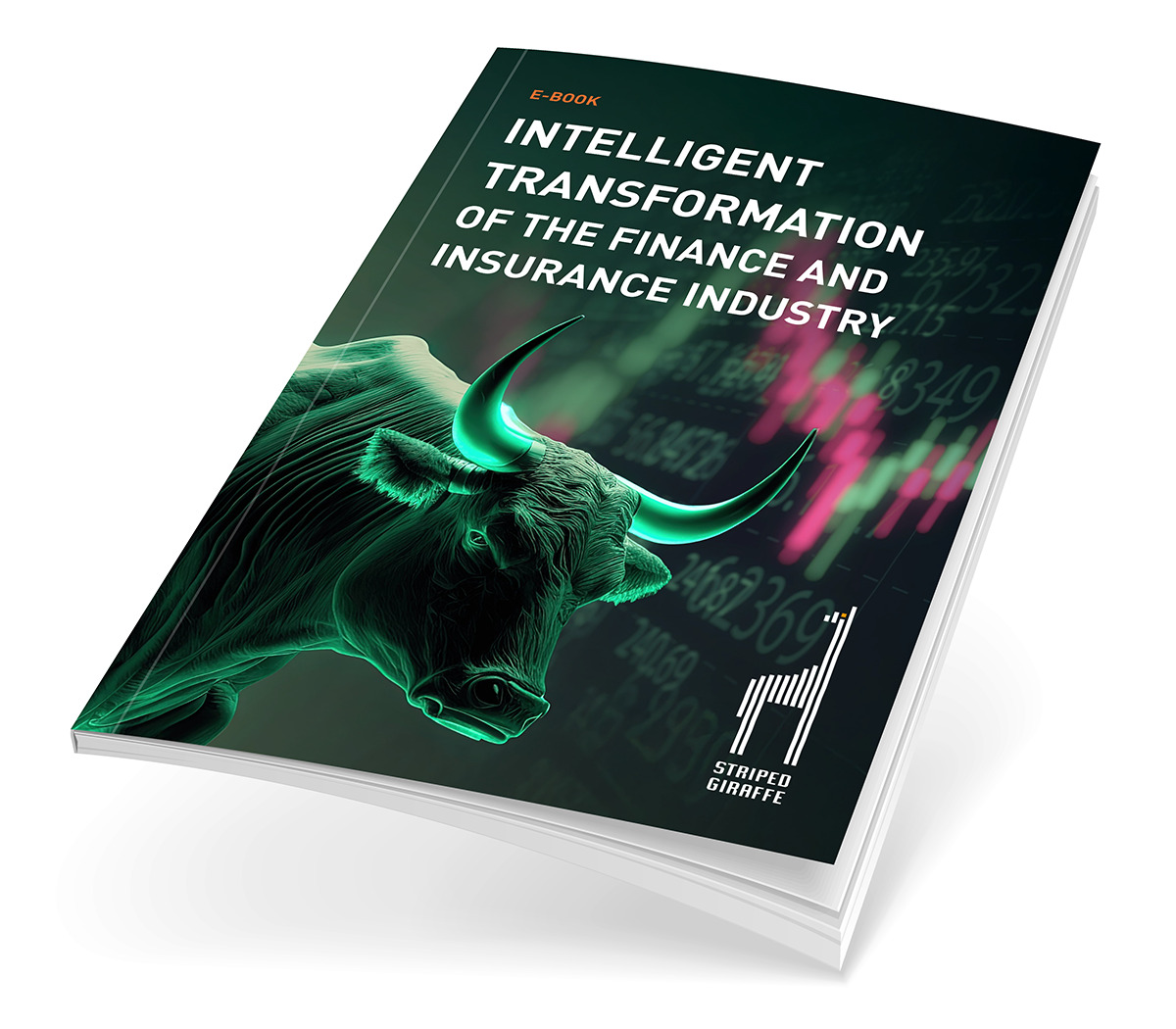
Download the E-Book Now
Simply fill out the form to receive the E-Book as a PDF.
Let’s talk
Do you need a specific offer or a sparring partner to discuss ideas?
Just contact us:
- experts@striped-giraffe.com
- +49 (0)89-416 126-667
We will be happy to support you.
WE CREATE ADDED VALUE FOR OUR CUSTOMERS.
This leads to a long-term cooperation with our customers, which we appreciate very much. You can find even more e-books, case studies, and co. in our Insights.