


E-BOOK
Personalization
as a Decision
Architecture
in E-Commerce
How relevance emerges when systems understand
what users actually need
In this
e-book
01 | Personalization as a Decision Logic
02 | From Rule Sets to Contextual Decisions
03 | Data as the Foundation for Decisions
04 | Trust as a Prerequisite for Personalization
05 | Measuring Impact Beyond Isolated KPIs
06 | Technological Foundations for Scalable Personalization
07 | Common Misconceptions
08 | Strategic Guiding Questions
Outlook: From Decision Models to Execution
Executive
Summary
For a long time, personalization was treated as a discipline of fine-tuning: a personalized subject line, a product slider on the homepage, a well-timed discount. These measures work — but they fall short. They react to behavior instead of improving decisions.
Modern e-commerce experiences no longer unfold along linear journeys or stable target groups. Users switch contexts, channels, and expectations in real time. They do not want to be addressed — they want to be understood. Relevance emerges where systems recognize situations and offer meaningful options, not where rules are merely executed efficiently.
Personalization, as it is needed today, is therefore neither a UX layer nor a campaign mechanism. It is a decision architecture in the background: data-driven, context-aware, and governable. This e-book shows how organizations can build personalization in a way that creates orientation, reduces complexity, and builds trust — instead of forcing attention.
01 |
Personalization as a Decision Logic
Personalization is often associated with visible elements such as recommendations, banners, or tailored content. But this perspective misses the point. Personalization does not answer a design question — it answers decision-making questions.
Every digital interaction implicitly involves choices: which products are shown, which information is prioritized, which next steps are suggested. Personalization defines the logic behind these choices.
As digital ecosystems grow more complex — with more channels, more content, and more options — this logic becomes a central steering mechanism. It influences not only conversion rates, but also orientation, decision speed, service quality, and long-term customer relationships.
02 |
From Rule Sets to Contextual Decisions
Many organizations still operate with a view of personalization shaped by a very different digital reality. Typical characteristics include:
- Predefined rules and if-then logic
- Static segments based on historical data
- Isolated personalization in marketing, commerce, and service
This model reaches its limits as soon as user behavior becomes situational, non-linear, and difficult to predict.
Mature personalization follows different principles:
- Context instead of segment
- Situation instead of persona
- Decision patterns instead of campaigns
The difference lies not primarily in technology, but in mindset. Personalization evolves from a delivery mechanism into continuous decision support.
03 |

Data as the Foundation for Decisions
Personalization rarely fails due to a lack of data, but rather due to a lack of decision logic. Many organizations collect vast amounts of information without clearly defining which decisions those data should support.
Data creates value only when it is consistently structured, up to date, and unambiguously interpretable. Relevance does not emerge from individual data points, but from coherent data models that describe situations.
Examples of consistent data models in an e-commerce context include:
- Product models that represent master data, variants, pricing, availability, and attributes consistently across all channels
- Customer and account models that clearly separate identity, roles, relationships, history, and preferences while keeping them logically connected
- Interaction models that interpret behavior not in isolation, but across time, context, and channels
These models form the basis of a decision layer where data is translated into concrete options: which content to prioritize, which products make sense, and which next steps provide orientation.
Such decision logic does not emerge in the frontend or in campaign setups. It is the result of structured data management.
Key prerequisites include:
- Master Data Management (MDM) to ensure consistent and trustworthy core data – more details
- Clear data governance defining ownership, quality criteria, and usage contexts – more details
- Transparent data flows that make it traceable where data originates, how it is enriched, and how it is used
Without these foundations, personalization becomes fragmented: recommendations contradict each other, context is lost, and automation amplifies inconsistencies.
Only when data is managed as a strategic asset can personalization move from reactive delivery to reliable decision support.
04 |
Trust as a Prerequisite for Personalization
Data protection is often perceived as a regulatory obligation. From a strategic perspective, however, it is a core component of effective personalization.
Modern personalization works only when users understand why their data is being used — and what concrete value they receive in return. Transparency, purpose limitation, and control are not constraints, but prerequisites for acceptance.
Organizations that actively design data protection:
- communicate data usage clearly and contextually
- make benefits immediately tangible
- enable active control over preferences and consent
Trust thus becomes not an obstacle, but the stable foundation of relevant digital experiences.
05 |
Measuring Impact Beyond Isolated KPIs
Personalization can be measured — but traditional success metrics often fall short because they focus only on end results.
Conversion rates and revenue matter, but they do not explain how decisions are made. Modern steering requires additional dimensions:
- Time to decision
- Return and retention rates
- Use of self-service and informational features
- Depth and quality of interaction
Especially for complex or consultative offerings, the value of personalization often manifests indirectly — through reduced friction, improved orientation, and greater decision confidence.
06 |

Technological Foundations for Scalable Personalization
Modern personalization requires an architecture that decouples decisions from interfaces and channels. It does not live in individual systems, but emerges from clearly defined architectural layers.
A proven platform approach typically includes:
- A consistent data layer (e.g., PIM, MDM, analytical platforms)
- A decision and intelligence layer where rules, models, and algorithms prepare decisions
- An experience layer that delivers these decisions contextually across touchpoints
Composable and headless architectures provide the necessary flexibility. They allow decision logic to evolve independently of frontends, enable new channels, and support iterative scaling of personalization.
In addition, data mesh and platform concepts are gaining importance. They enable decentralized responsibility for data products while maintaining clear governance guidelines — a critical prerequisite for scalable personalization in complex organizations.
Technology is not an end in itself. It defines the framework within which personalization remains controllable, extensible, and sustainable over time.
07 |
Common Misconceptions
Many personalization initiatives fail not because of missing tools, but because of structural misconceptions:
- More automation automatically leads to better relevance
- Personalization is primarily a marketing topic
- Visible adaptations are equivalent to value creation
Successful personalization starts with clear principles — not with maximum automation.
08 |
Strategic Guiding Questions
Before investing in new tools or use cases, organizations should address fundamental questions:
- Which decisions should personalization support?
- In which situations does personalization help — and when does it not?
- How much control should remain with the user?
- Which organizational prerequisites must be in place?
Personalization is not a project, but a capability. Those who build it strategically lay the foundation for scalable, relevant, and trustworthy digital experiences.
Outlook
From Decision Models to Execution
This e-book has shown why personalization must be understood as a strategic decision architecture — and which prerequisites are required to build it. But even the most robust model creates no impact on its own.
The next step is translating these principles into concrete applications: along real usage situations, across all touchpoints, and with clear prioritization. Only then does it become visible how decision logic performs in everyday practice — and where it creates real value.
The second e-book takes exactly this step: from strategic foundations to practical implementation. With concrete use cases, decision patterns, and best practices that demonstrate how modern personalization actually works in e-commerce.
Download
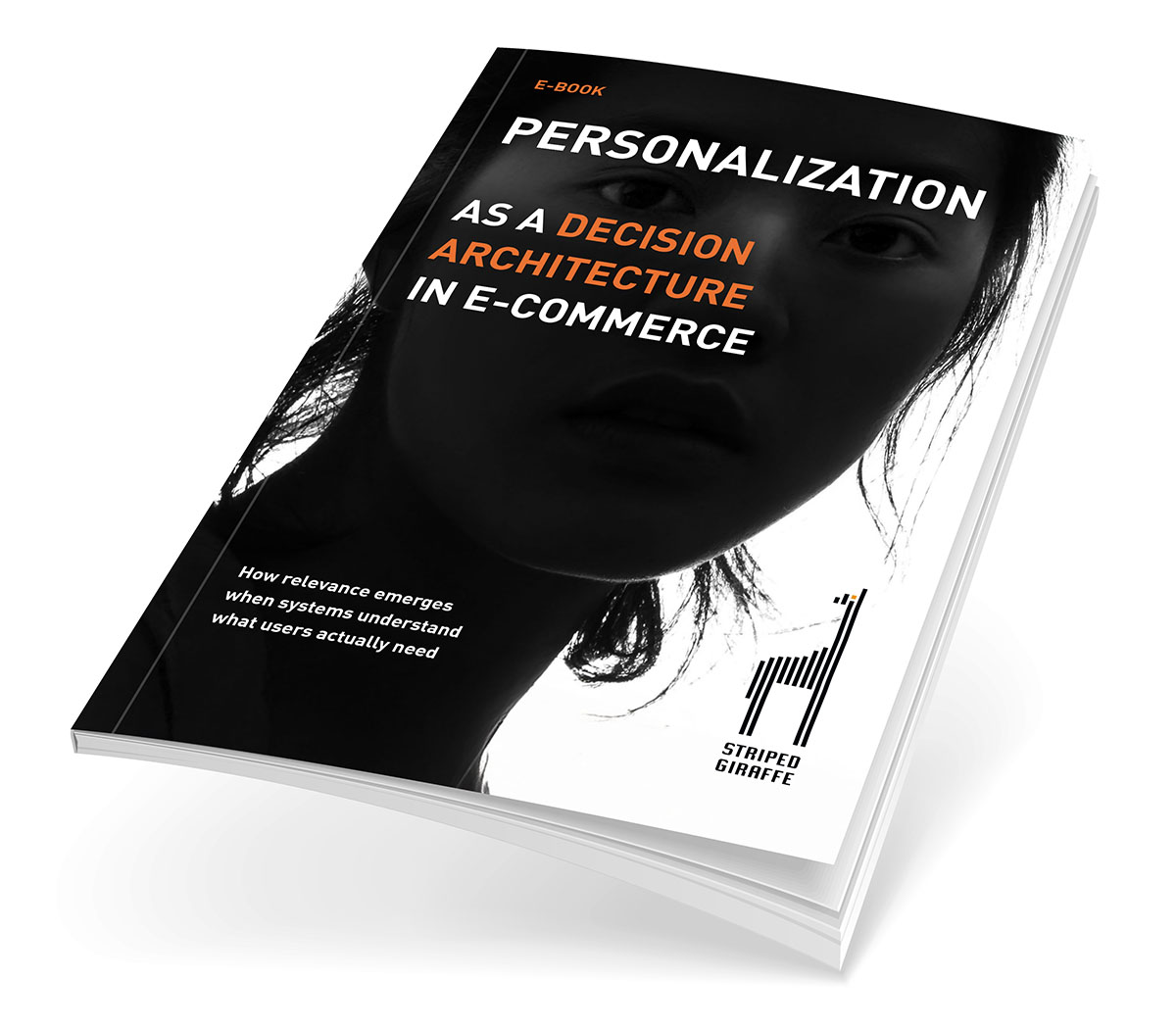
Download the e-book now
A structured orientation for decision-makers who understand personalization not as a feature, but as a strategic capability. Simply fill out the form to receive the E-Book as a PDF.
Let’s talk
Do you need a specific offer or a sparring partner to discuss ideas?
Just contact us:
- experts@striped-giraffe.com
- +49 (0)89-416 126-667
We will be happy to support you.
WE CREATE ADDED VALUE FOR OUR CUSTOMERS.
This leads to a long-term cooperation with our customers, which we appreciate very much. You can find even more e-books, case studies, and co. in our Insights.